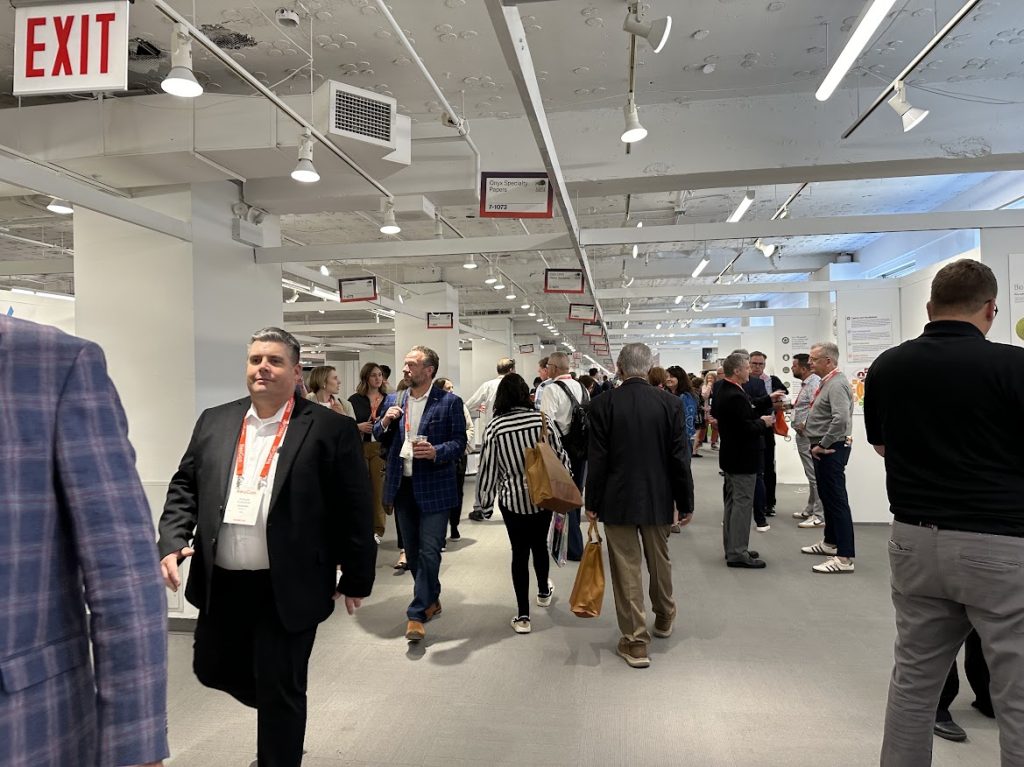
Walk any trade show floor—NeoCon included—and you’ll see hundreds of commercial carpet options. Same sizes. Similar colors. Comparable price points. So how do you cut through the noise and choose the right product for your project?
After years of supplying carpet tiles to offices, hospitals, schools, and hotels across multiple markets, the team at TEFLOOR has learned that the best purchasing decisions come down to five questions. If your shortlisted supplier can’t answer all five clearly, keep looking.
1. What’s the actual pile weight—and can you prove it?
Pile weight drives everything: appearance retention, acoustic performance, and long-term durability. For true commercial-grade carpet tiles, anything below 400g/㎡ is a red flag for high-traffic environments. Ask for mill test reports, not just sales sheets. At TEFLOOR, our standard starts at ≥400g/㎡—and we’ll put the documentation in your hands before you sign.
2. How tight is the thickness tolerance?
A carpet tile might be listed as “6mm,” but what’s the allowable variance? ±1mm sounds small until you’re dealing with a 10,000-square-foot open office where even minor height differences create tripping hazards and visible irregularities. TEFLOOR holds total thickness to 6mm±0.2mm across production runs. Consistency isn’t a bonus feature—it’s the foundation of a professional installation.
3. Can you hit FR requirements without compromising hand feel?
This is where many imported products stumble. Yes, you can treat polyester with chemical retardants to pass a burn test. But the result often feels stiff, smells unpleasant, and fades unevenly. For spaces with fire-code obligations, TEFLOOR’s recommendation is consistent: specify nylon yarn. Inherent FR performance, superior resilience, and the tactile quality your end users expect.
4. What certifications cover this exact product—not just the category?
“All our products are certified” is a common claim. The follow-up question should be: which certificates apply to this specific SKU? TEFLOOR provides full documentation—flammability, VOC emissions, abrasion resistance, and colorfastness—for every product family we bring to market, including the collections shown at NeoCon. No guessing. No fine print.
5. What happens after the warranty period ends?
Carpet warranties are easy to print. Service is harder to deliver. Ask your supplier: Do you maintain spare inventory for future replenishment? Can you match dye lots two years from now? Do you support phased renovations where old and new tiles must coexist seamlessly? TEFLOOR structures our production and inventory planning specifically to support these long-cycle realities.
The Bottom Line
Commercial carpet isn’t a commodity purchase. It’s a long-term infrastructure decision that affects maintenance budgets, occupant satisfaction, and even talent retention. The right supplier makes your job easier; the wrong one becomes a problem you inherited.
TEFLOOR isn’t the biggest name in commercial carpet yet. But we’re building our reputation one specification at a time—by answering these five questions honestly, every single time.