If Sangetsu is the “design editorial” of the Japanese interior materials world, then TAJIMA is more like a “ground systems engineering firm.”
Founded in 1919 and pivoting toward flooring, waterproofing, and landscaping systems after 1952, TAJIMA has become one of Japan’s leading players in the commercial flooring market. In Japanese flooring circles, it’s known for being equally proficient in both resilient sheet vinyl and carpet tiles. In China’s project-specification world, TAJIMA is often mentioned alongside PVC resilient flooring—but its commercial carpet tile line is just as formidable. It just doesn’t sell itself on pattern stories; it sells on durability, chemical resistance, low VOCs, and ease of installation.
Why Engineers Actually Specify TAJIMA Carpets
1. Solution-Dyed Nylon + Lightweight Backing Is the Default Standard
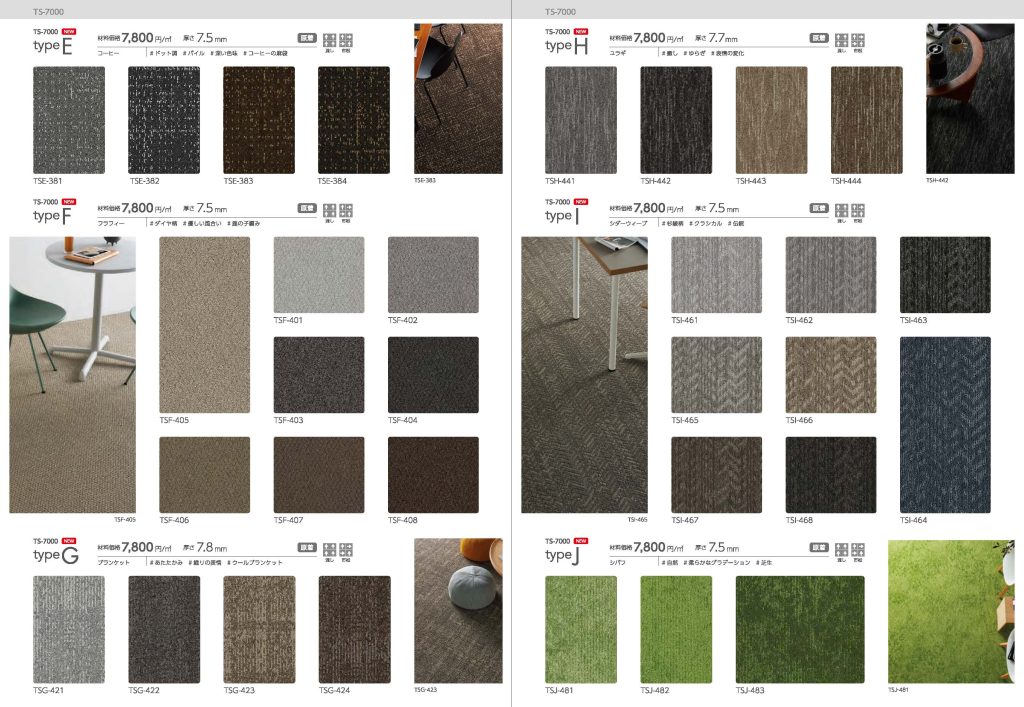
Take the TS-7000 typeJ / TSJ-481–483 series (available in the Japanese market) as examples:
- Pile: 100% solution-dyed nylon—colorfastness, UV resistance, and chemical-cleaner tolerance are all engineered for commercial duty
- Backing: Specialty PVC + glass-fiber nonwoven lightweight backing; 500×500mm format, ~7.5mm thick; 16 tiles per carton (4m²)
- Construction: Textured loop pile with high/medium/low multi-level tuft heights—no hollow underfoot feel, resistant to castor-wheel compression
Spec this into office areas, conference rooms, or hospital corridors, and you’re looking at “three years later, you still can’t tell where the main walkways are” territory.
2. They Ported Their Vinyl Flooring Logic Into Carpet Thinking
TAJIMA built its name on PVC sheet flooring, so its carpet line carries unmistakable “flooring manufacturer DNA”:
- Low-VOC, zero-formaldehyde orientation, aligned with CRI Green Label Plus, Eco Mark, and Japan’s Green Procurement Law compliance frameworks
- Chemical resistance, antimicrobial properties, soil repellency, and static control—not the “light spill protection” of residential rugs, but hospital/lab/server-room-grade toughness
- Class B1 fire rating, sound absorption, slip resistance, no-wax maintenance logic carried over from their broader resilient flooring portfolio
This is why TAJIMA frequently appears in Chinese hospitals (Zhongshan, Huashan), airports, and schools—often as a “carpet + sheet vinyl package deal.”
3. Recycled Content and Carbon Footprint Data That Belong in Spec Books
Select TAJIMA carpet tile lines carry Recycled Carpet Certification (Japan Recycling Carpet Association framework): disclosed carbon footprint, 25%+ post-consumer recycled (PCR) content, and material-separable recyclability. For projects pursuing LEED or WELL certification, this is far easier to document than brands that merely claim “we feel very eco-friendly.”
4. Understated Design That Stays Out of the Way
TAJIMA’s visual language leans toward:
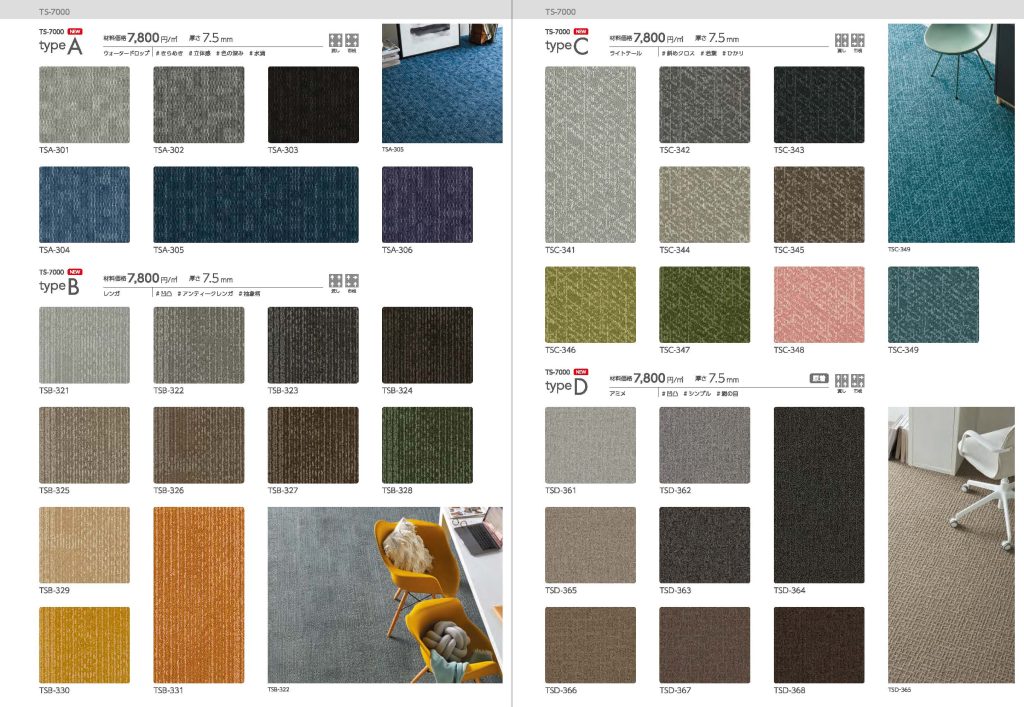
- Fine-heather textures, micro-stripes, stone-chip effects, lawn-like surfaces (e.g., TS-7000 typeJ “Shibafu” turf tone)
- Neutral greys, browns, blues, and greens—minimal large-scale color blocking
- Designed to coordinate seamlessly with TAJIMA’s own PVC sheet flooring and transition strips
In other words: it won’t make your space “pop,” but it will keep it from going wrong.
TAJIMA vs. Sangetsu: How to Choose Without Overlap
| Dimension | TAJIMA | Sangetsu |
|---|---|---|
| Brand DNA | Flooring/waterproofing systems engineer | Integrated interiors house (wallcoverings, curtains, carpets) |
| Carpet Strengths | Bulletproof commercial tiles, chemical resistance, low VOCs, vinyl coordination | NT700 reflectance optimization, ECO GRADE, Kengo Kuma collabs, design-forward lines |
| Design Language | Neutral, restrained, contractor-friendly | Color transitions, shadow-and-light aesthetics, Morris home collection |
| Best Fit For | Hospitals, schools, high-traffic offices, server rooms | HQ building lobbies, ABW neighborhoods, boutique hotel common areas, residential rugs |
| China Presence | Mature South-China agency network + project warehouses; massive PVC flooring installed base | Shanghai warehouse with ~42 NT700 stock colors; strong designer-spec recognition |
Bottom line: Need “bombproof + certifiable + unified vinyl transitions”? Go TAJIMA. Want “emotional spatial character + lighting strategy + creative tile layouts”? Go Sangetsu.
3 Installation Notes for Project Teams
- Arrow direction matters. TAJIMA tiles have directional arrows on the back. Lock in your layout—standard checkerboard or linear flow—on the drawings before site delivery, otherwise textured lines like Misty will show visible shading variation (this applies to Sangetsu too).
- Moisture testing is non-negotiable. These are carpet tiles, not flood barriers. Raised access floors and self-leveling compounds must hit specified moisture thresholds before installation begins.
- Coordinate transitions early. If you’re pairing TAJIMA carpet tiles with TAJIMA sheet vinyl (a common combo in hospitals and labs), order transition strips and edge profiles in the same spec cycle. One vendor, one warranty, one site meeting—much cleaner.
The Bottom Line
What makes TAJIMA distinctly Japanese isn’t a particular pattern vocabulary—it’s the refusal to let the floor become a maintenance liability. Every specification decision traces back to a question: will this still perform on year four of a 24/7 facility?
If you’re furnishing a hospital corridor, a school hallway, a trading-floor office, or anywhere the floor takes daily punishment, TAJIMA is the quiet choice that won’t call attention to itself—until someone asks why your five-year-old carpet still looks new.