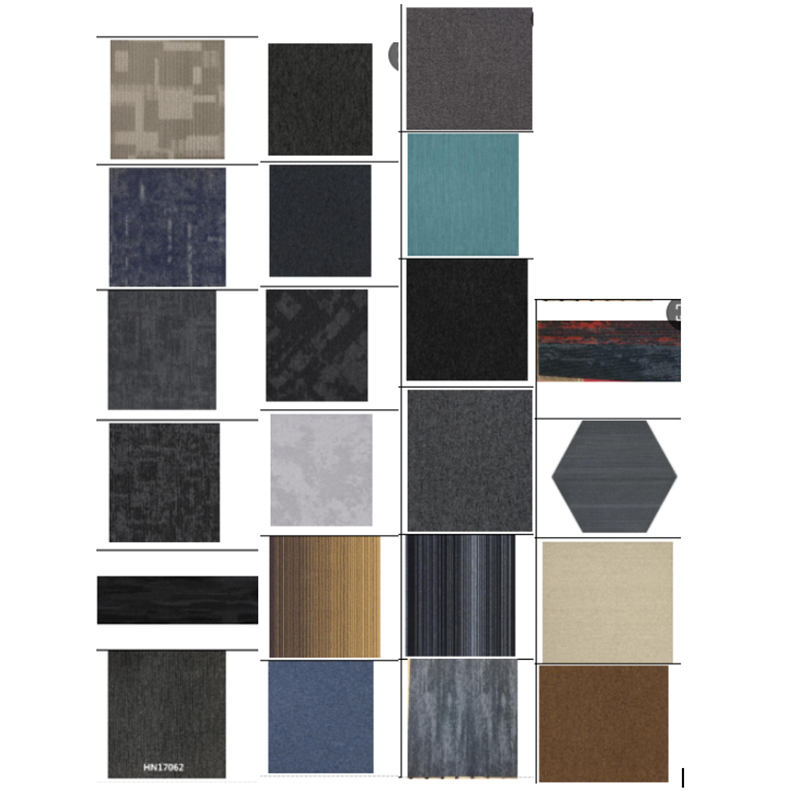
Most carpet tile spec sheets stop at “nylon, 500×500mm, PVC back.” But the reason two tiles that look alike on a screen wear completely differently on the floor is buried in pile construction, yarn dye method, and tufting gauge logic. For TEFLOOR-style export-grade commercial tiles—the ones sourced against Shaw / Interface / Mohawk equivalent constructions—these are the terms that separate a 3-year tile from a 10-year tile.
1. High-Low Loop (高低圈) vs. High-Low Cut-and-Loop (高割低圈 / 高圈低割)
Multi-level loop / high-low loop means the yarn stays uncut, but the tufting machine varies loop height—typically 3–5 mm high loops against 2–3 mm low loops. The height gap itself becomes the pattern (ice-crack, stone, micro-grid). Because nothing is cut, the fiber ends are still locked in the loop, so it resists crushing and hides footprints better than cut pile. This is the workhorse for office main corridors, co-working, education.
- 高圈低割 (high loop + low cut): the raised portions stay as loops, the recessed portions are tip-sheared. You get loop durability in the high areas and a softer visual break in the low areas.
- 高割低圈 (high cut + low loop): the raised portions are cut (velvety, catches light), the recessed portions stay loop (durable, shadows the pattern). More designer-looking, slightly less bulletproof on castor chairs than pure loop.
Rule of thumb: pure multi-level loop for heavy traffic; cut-and-loop for executive floors, meeting pods, and low-traffic hospitality where texture matters more than abrasion score.
2. Multi-Color Jacquard on a Tufting Machine (高低圈多色提花)
“Jacquard” in carpet-tile context does not mean woven Jacquard loom—it means a computer-controlled multi-yarn, multi-height tufting head. A 6-color jacquard tufter can switch yarn feed and pile height row-by-row, so a 50×50 tile shows 3–6 colors without printing.
Two mechanisms combine:
- Color from yarn sequence: solution-dyed nylon cones in different colors are fed per needle group; no dye lot drift.
- Pattern from height masking: in a high-cut + low-loop setup, the taller cut yarn visually covers the recessed color unless the design wants it peeked. Chinese patents describe exactly this—1:1 color yarn交替, tall pile shows color A, short pile hides color B.
This is how TEFLOOR-type factories turn a plain tufting line into “stone-with-veining” or “abstract topographic” tiles at export price points.
3. Solution-Dyed Nylon (尼龙色纱原液纺织)
Not “yarn dyed,” not “piece dyed.” Solution dyeing mixes pigment masterbatch into the nylon polymer melt before extrusion, so the filament is colored all the way through.
- Nylon 6 or Nylon 6,6 (6,6 better on abrasion/resilience, 6 cheaper and fine for mid-tier)
- Colorfastness to light >6 (ISO 105-B02), bleach and solvent resistant
- No dye-house wastewater, batch-to-batch ΔE tiny—critical for 4,000 m² office reorders
For commercial tiles, 100% solution-dyed nylon 6,6 is the Shaw/Interface baseline; solution-dyed nylon 6 is the TEFLOOR/Pacific-export compromise that hits the price target without looking residential.
4. The “8+4” and “6+6” Codes — Gauge Logic, Not Oz Weight
This is the most misread line on Chinese factory specs. In tufting:
- Gauge = needles per inch along the width. 1/10″ gauge = 10 needles/inch. 1/12″ = 12 needles/inch (denser). 5/64″ = coarse gauge for chunky loop.
- “6+6” = a dual-beam tufting machine: one beam controls a 1/6″ gauge row, another beam controls another 1/6″ gauge row, offset, allowing two pile heights / two yarn groups in one pass. Common for 6+6 multi-level loop nylon tile at 550 gsm face weight.
- “8+4” = 1/8″ gauge beam + 1/4″ gauge beam combined; the 1/8 gives fine detail, the 1/4 gives bolder texture. Used on high-low cut-and-loop jacquard where you want both crisp fine lines and deep sculpted areas.
So when a TEFLOOR spec says “gauge 1/8+4, 6+6 optional, solution-dyed PA6, 480–560 gsm, PVC/POE back,” it is telling you:
- machine can do fine + coarse rows simultaneously
- pattern can mix loop/height/color in one tile
- face weight is commercial heavy (Class 33 territory)
- backing is swap-able for acoustic PU or bitumen
It is not saying “8 oz + 4 oz face weight”—that’s a residential broadloom way of reading it and will get your spec laughed out of a flooring QS meeting.
5. How TEFLOOR-Type Tiles Stack These Options
| Construction | Typical Spec | Best Zone |
|---|---|---|
| Level loop | 1/12 PA6 SD, 480 gsm, PVC | Server rooms, back-of-house |
| Multi-level loop (高低圈) | 6+6 gauge, 3/5mm hi-lo, PA6 SD | Open office, school, corridor |
| High cut + low loop (高割低圈) | 8+4 tuft, tip-sheared high, 4/2mm | MD/exec floors, hotel guestroom corridor |
| High loop + low cut (高圈低割) | 8+4 tuft, loop high, shear low | Lobby feature tile, boutique office |
| Multi-color jacquard hi-lo | 6-color feed, 6+6 or 8+4, PA6.6 SD | Wayfinding zones, brand-colored hubs |
6. Three Spec Traps to Avoid
- “Nylon” without “solution-dyed” → piece-dyed nylon in a sunlit office will show seams in 18 months. Insist on SD.
- “8+4” assumed as weight → ask the factory to confirm gauge beams vs. oz/yd². Face weight should be written as gsm (e.g., 550 g/m²) separately.
- Cut-and-loop in a 24/7 castor zone → the cut portions will mat first. If you must use 高割低圈 in a hot-desking area, push face weight ≥600 gsm and PA6,6.
Bottom Line
A TEFLOOR-grade export tile is not “a cheap carpet.” It is a configurable construction system:
solution-dyed nylon + 6+6 / 8+4 dual-beam tuft + high-low loop or cut-and-loop + jacquard yarn sequencing + PVC/POE/acoustic back.
Once you read the spec in that order, you stop comparing tiles by thumbnail and start comparing them by how they’ll look in month 36.